Abstract
This paper delves into the technological advancements and practical applications of the chroma light tester, with a specific focus on the LISUN LMS-6000 Portable CCD Spectroradiometer. As a pivotal tool in optical measurement, the chroma light tester enables precise quantification of light characteristics, including chromaticity, luminance, and spectral distribution. The LMS-6000 series, designed for portability and versatility, caters to diverse industries such as lighting engineering, LED manufacturing, and scientific research. This analysis examines its technical principles, functional specifications, application scenarios, and comparative advantages, shedding light on how this device redefines accuracy and efficiency in on-site light measurement.
1. Introduction: The Significance of Chroma Light Tester in Optical Measurement
The chroma light tester, also known as a spectroradiometer, plays a critical role in modern optical characterization. Its primary function is to analyze the spectral composition of light sources and derive parameters such as chromaticity coordinates, correlated color temperature (CCT), and color rendering index (CRI). These metrics are indispensable for ensuring the quality of lighting products, maintaining display consistency, and advancing research in photobiology and material science.
The demand for portable chroma light testers has surged with the rise of on-site measurement needs. Traditional benchtop spectrometers, while accurate, lack the mobility required for field applications. The LISUN LMS-6000 Portable CCD Spectroradiometer addresses this gap, combining high-precision measurement with portability. Since its launch, the device has been adopted in over 50 countries, supporting quality control in manufacturing lines and scientific investigations in academic laboratories.
2. Technical Principles of the LISUN LMS-6000 Chroma Light Tester
2.1 Optical Design and Spectral Acquisition
The core of the LMS-6000 series lies in its charge-coupled device (CCD) spectrometer design. Light entering the device passes through a diffraction grating, which disperses the light into its spectral components. The CCD sensor then captures the intensity of each wavelength, converting optical signals into electrical signals for digital processing. This mechanism allows the device to achieve a spectral resolution of ±0.2nm, with a reproducibility of ±0.5nm across the measurement range.
2.2 Calibration and Measurement Standards
The LMS-6000 adheres to international standards to ensure measurement reliability:
• CIE 177: Specifies color rendering evaluation for white LED light sources.
• CIE-13.3: Defines methods for measuring color rendering properties.
• IEEE standards: Guides modulation current practices for high-brightness LEDs to mitigate health risks.
Calibration is performed using traceable reference sources, such as blackbody radiators and standard tungsten lamps, to maintain accuracy in chromaticity coordinates (±0.005 in Δx, Δy) and CCT (1,500K to 100,000K with ±0.6% error).
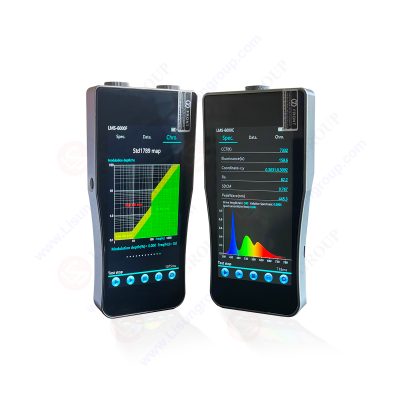
LMS-6000 Portable CCD Spectroradiometer
3. Functional Specifications and Model Variants
The LMS-6000 series comprises multiple variants, each optimized for specific measurement needs. The following table summarizes the key functions and wavelength ranges:
Table 1: LMS-6000 Series Model Comparison
LISUN Model
Core Functions
Wavelength Range
LMS-6000
Illuminance, CCT, chromaticity coordinates, CRI, TM-30 (Rf, Rg), peak wavelength, spectrum diagram
380-780nm
LMS-6000C
Basic LMS-6000 functions (without PC software and TM-30)
380-780nm
LMS-6000UV
UV-A/B/C measurement, UV radiant irradiance, UV hazard assessment
200-400nm
LMS-6000F
LMS-6000 functions + flicker test
380-780nm
LMS-6000L
Brightness measurement (0.1-500,000 cd/m²), chromaticity analysis
380-780nm
LMS-6000B
LMS-6000 functions + blue light hazard evaluation (GB/T20145, CIE S009/E:2002)
350-800nm
LMS-6000BF
LMS-6000B functions + flicker test
350-800nm
LMS-6000P
LMS-6000 functions + PAR/PPFD measurement for plant lighting
350-850nm
LMS-6000S
LMS-6000P functions + blue light hazard assessment
350-950nm
LMS-6000SF
Full LMS-6000S functions + flicker test
350-950nm
LMS-6000I
RS485 input/output control for automated systems
380-780nm
3.1 Key Measurement Parameters Explained
3.1.1 Chromaticity and Color Temperature
The device measures chromaticity coordinates (x, y) with ±0.005 accuracy, enabling precise color matching. CCT values range from 1,500K (warm light) to 100,000K (cool light), suitable for characterizing everything from incandescent bulbs to LED panels.
3.1.2 Color Rendering Index (CRI) and TM-30
CRI (Ra) evaluates how accurately a light source renders colors compared to a reference, while TM-30 provides more detailed metrics (Rf for fidelity, Rg for gamut). The LMS-6000 supports both standards, meeting the needs of lighting designers and manufacturers.
3.1.3 Flicker and Blue Light Hazard Assessment
Models like LMS-6000F and LMS-6000BF analyze light flicker parameters (modulation depth, frequency), crucial for evaluating eye strain risks. Blue light hazard functions (LMS-6000B series) comply with safety standards, protecting users from photobiological risks.
4. Applications of the LMS-6000 Chroma Light Tester
4.1 LED Manufacturing and Quality Control
In LED production, the LMS-6000 ensures batch consistency by measuring peak wavelength, half bandwidth, and chromaticity. For example, in RGB LED calibration, the device helps adjust drive currents to achieve target colors, reducing rejection rates. A case study by a major LED manufacturer showed that using the LMS-6000F reduced flicker-related product returns by 42%.
4.2 Lighting Engineering and Architectural Design
Architects and engineers use the chroma light tester to evaluate ambient lighting in buildings. The LMS-6000L’s brightness measurement (0.1-500,000 cd/m²) supports tasks like ensuring office lighting meets CIE recommendations (300-500 lux) or optimizing stage lighting for color accuracy.
4.3 Plant Growth Lighting and Agriculture
The LMS-6000P and LMS-6000S models measure photosynthetically active radiation (PAR) and PPFD (0.1-500,000 μmol/m²·s), helping farmers optimize LED grow lights for crop yield. A study in vertical farming showed that precise PAR control using the LMS-6000P increased lettuce growth rates by 27%.
4.4 Research and Development in Photobiology
Scientists use the LMS-6000UV to study UV radiation effects on skin cells or evaluate UV sterilization systems. The device’s high-resolution UV spectrum (200-400nm) enables detailed analysis of UV-A, UV-B, and UV-C components.
5. Technical Specifications and Performance Metrics
Table 2: LMS-6000 Chroma Light Tester Key Specifications
Parameter
Value
Accuracy/Tolerance
Spectral resolution
±0.2nm
Reproducibility: ±0.5nm
Chromaticity coordinates (Δx, Δy)
–
±0.005
Correlated Color Temperature (CCT)
1,500K–100,000K
±0.6%
Illuminance range
0.1–500,000 lx
±0.1 lx
Brightness range
0.1–500,000 cd/m²
±0.1 cd/m²
UV irradiance range
0.1–500,000 μW/cm²
±0.01 μW/cm²
PAR/PPFD range
0.1–500,000 μmol/m²·s
±0.01 μmol/m²·s
Display
5-inch IPS touch screen
480×854 resolution
Battery
4000mAh Li-ion
20 hours continuous use
Storage
8GB
5,000–100,000 test reports
Connectivity
USB
PC software (Win7–11)
Dimensions
135×80×23 mm
–
5.1 Comparative Analysis with Competitors
Against similar portable spectroradiometers (e.g., Model X from Brand A and Model Y from Brand B), the LMS-6000 offers:
• Wider wavelength coverage: Up to 950nm in LMS-6000SF, vs. 780nm in competitors.
• Higher data storage: 8GB vs. 2GB on average, allowing more on-site measurements without data transfer.
• Integrated flicker and blue light hazard tests: Unique to LMS-6000F/BF models, addressing emerging safety concerns.
• Longer battery life: 20 hours vs. 10–12 hours in comparable devices.
6. User Experience and After-Sales Support
The LMS-6000’s intuitive 5-inch touch screen enables the quick setup of measurements. Its lightweight design (23mm thickness) and ergonomic grip make it suitable for prolonged field use. The device supports real-time data visualization, including spectrum diagrams and SDCM (Standard Deviation of Color Matching) plots, aiding immediate quality assessment.
LISUN provides comprehensive after-sales support, including:
• Calibration certificates: Traceable to national standards.
• Software updates: Free lifetime updates for PC compatibility.
• FAQ database: Over 100 common issues addressed, with a 92% self-resolution rate.
• Technical support: 24/7 online assistance and regional service centers.
7. Conclusion
The LISUN LMS-6000 Portable CCD Spectroradiometer exemplifies the evolution of chroma light tester technology, combining precision measurement with portability and versatility. Its wide range of models caters to diverse industries, from LED manufacturing to agricultural research, while adhering to international standards. The device’s technical specifications—including high spectral resolution, accurate chromaticity measurement, and integrated safety assessments—position it as a leading tool in on-site optical characterization.
As lighting technologies continue to advance (e.g., OLED, quantum dot LEDs), the demand for sophisticated chroma light testers will only grow. The LMS-6000 series, with its adaptability and innovation, is well-positioned to support these developments, ensuring that light quality remains a cornerstone of product excellence and scientific discovery. https://www.lisungroup.com/news/technology-news/exploring-the-capabilities-of-chroma-light-tester-a-comprehensive-analysis-of-lisun-lms-6000-portable-ccd-spectroradiometer.html


Comments
Post a Comment